posted by peterga at 12:05 AM
0 comments


Sunday, February 03, 2008
Friday, April 14, 2006
General Dismay
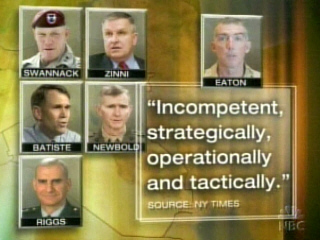
If *any* number of egregious errors of Rumsfeld et. al., as reported by the Generals of our nation's military forces, could *possibly* make the administration's defenders change their mind, I'd like to know how much more it would take than these critics:
- Major General John Batiste, commander of a division in Iraq - "I believe we need a fresh part in the Pentagon."
- Marine Lt. General Gregory Newbold, director of operations for the Joint Chiefs of Staff - "We need fresh ideas and fresh faces. That means, as a first step, replacing Rumsfeld .."
- Army Major General Paul Eaton, overseer of training of Iraqi troops - "Rumsfeld must step down."
- General Charles Swannack, Commander 82nd Airborne - "We need a new secretary of defense."
- Marine General Anthony Zinni, CENTCOM commander - Asked who should step down "The Secretary of defense to begin with."
- Major General Jon Riggs - ">“They only need the military advice when it satisfies their agenda. I think that’s a mistake, and that’s why I think he should resign.”
- Army General Eric Shinseki
You can dismiss complaints from Pete, as a partisan against Bush. But I'd urge anyone who cares more about the country and our military men and women to read the extent and breadth of the comments below from generals of our military forces, and tell me then if they don't think Rumsfeld et. al. are a serious, serious problem.
- 'For that reason, Secretary of State Condoleezza Rice's recent statement that "we" made the "right strategic decisions" but made thousands of "tactical errors" is an outrage. It reflects an effort to obscure gross errors in strategy by shifting the blame for failure to those who have been resolute in fighting. The truth is, our forces are successful in spite of the strategic guidance they receive, not because of it.' (Newbold)
- I think a weakened, fragmented, chaotic Iraq - which could happen if this isn't done carefully - is more dangerous in the long run than a contained Saddam is now ... I don't think these questions have been thought through or answered," (Zinni)
- "The cost of flawed leadership continues to be paid in blood. We need fresh ideas and fresh faces, and that means as a first step, replacing Rumsfeld and many others unwilling to fundamentally change their approach." (Newbold)
- "In sum, he has shown himself incompetent strategically, operationally and tactically and is far more than anyone else responsible for what has happened to America's mission in Iraq. Rumsfeld must step down." (Eaton)
- "I think we are paying the price for the lack of credible planning, or the lack of a plan. We're throwing away 10 years worth of planning, in effect, for underestimating the situation we were going to get into, for not adhering to the advice that was being given to us by others, and, I think, getting distracted from Afghanistan and the war on terrorism that we were committed to when we took on this adventure." (Zinni)
- "I think we need senior military leaders who understand the principles of war and apply them ruthlessly, and when the time comes, they need to call it like it is. (Swannack)
- "We grow up in a culture where accountability, learning to accept responsibility, admitting mistakes and learning from them was critical to us. When we don't see that happening it worries us. (Zinni)
- "I think that our executive and legislative branches of government have a responsibility to mobilize this country for war. They frankly have not done so. We're mortgaging our future, our children, $8 to $9 billion a month." (Batiste)
- "And I believe he has culpability associated with the Abu Ghraib prison scandal and, so, rather than admitting these mistakes, he continually justifies them to the press ... and that really disallows him from moving our strategy forward." (Swannack)
- "Rumsfeld has put the Pentagon at the mercy of his ego, his Cold Warrior's view of the world and his unrealistic confidence in technology to replace manpower. As a result, the U.S. Army finds itself severely undermanned - cut to 10 active divisions but asked by the administration to support a foreign policy that requires at least 12 or 14." (Eaton)
- We just heard the secretary of state say these were tactical mistakes. They were not tactical mistakes. These were strategic mistakes, mistakes of policies made back here." (Zinni)
- When they knew the plan was flawed, saw intelligence distorted to justify a rationale for war, or witnessed arrogant micromanagement that at times crippled the military's effectiveness, many leaders who wore the uniform chose inaction. A few of the most senior officers actually supported the logic for war. Others were simply intimidated, while still others must have believed that the principle of obedience does not allow for respectful dissent. The consequence of the military's quiescence was that a fundamentally flawed plan was executed for an invented war, while pursuing the real enemy, al-Qaeda, became a secondary effort. (Batiste)
- "Only General Eric Shinseki, the army chief of staff when President George W. Bush was elected, had the courage to challenge the downsizing plans. So Rumsfeld retaliated by naming Shinseki's successor more than a year before his scheduled retirement, effectively undercutting his authority. The rest of the senior brass got the message, and nobody has complained since." (Eaton)
- "Everyone pretty much thinks Rumsfeld and the bunch around him should be cleared out.” (Riggs)
- "I think America's media is being made a scapegoat for what's going on out there. At last count, I think something like 80 journalists have been killed in Iraq." (Zinni)
- Rumsfeld himself, responding to Generals saying it would take 200,000 troops to control Iraq after Saddam's downfall: "wildly off the mark...I am reasonably certain that they will greet us as liberators, and that will help us to keep requirements down."
- "Donald Rumsfeld is not competent to lead America's armed forces." (Eaton)
posted by peterga at 12:04 PM
1 comments
Tuesday, February 07, 2006
Some Larger Questions Behind the Bush Abuses
About three years ago, while my team was working on an e-mail system for a large financial corporation, we met with the makers of a product that made responding to customer e-mail more efficient by applying fancy logic to automatically match the customer's e-mail to our set of pre-defined answers. The package applied Natural Language Programming (NLP) and Artificial Intelligence (AI) logic to the e-mail text, and would continually learn, as human beings -- customers and call center agents -- confirmed or disconfirmed its guesses. The result was that the application could find relevant information where humans would not have guessed -- e.g. sometimes as little as the tense or conjugations used could be relevant factors in understanding what the customer wanted to know.
During this particular meeting, the CEO and founder of the company, an ex-Israeli Intelligence agent, dropped the fact that their product was used by one nation's government to monitor large amounts of e-mail, looking for clues to anti-government activities. Of course he would not tell us which nation, though my friend Sudhir, who is much better at reading between the lines than I, later told me with some confidence that it was the Phillipines. In any case, it went without saying that it must be a relatively totalitarian regime -- one without anything like the civil rights protections and concern for individual liberties of the United States.
Since then we have learned that similar systems are being used to monitor thousands of communications of Americans with persons overseas without a warrant. The Bush administration has tried to lead citizens to believe that these are only calls involving al Qaeda suspects, but we can logically conclude that the surveillance has extended well beyond the kind of linkages we would normally associate with such phrases, let alone the legal definition of "probable cause." Further, this sort of data minining is aimed less at monitoring known suspects and more at *identifying* suspects -- from data trends human beings alone would normally not notice. Putting aside, for the moment, the apparent lack of productiveness of this NSA tapping and the administration's self-serving deceptions, there *should* be a robust debate about this topic, involving the administration, the Congress, and ultimately, the American people.
That is, given that we can have in place checks and balances consistent with the Constitution and a reasonable barrier to abuse, how willing should we be to let software cull vast numbers of communications for patterns -- *before* the communicating parties are likely suspects in any criminal behaviors -- in order to diminish the odds of egregious crimes? What kind of "hit rate" would be needed to justify the intrusion? If no human looked at particular message (and the old "corpus" of messages would eventually be destroyed) until computer analysis revealed that at least party was 40% likely to be involved in planning terrorist activities, would it be acceptable for the computers to monitor *all* voice and email communications? 60% likely? 90% likely? If the system could identify an estimated 2 terrorist planners a year, would that justify computers sifting through everyone's electronic communications? How should we modify the laws (or even the Constitution?) to deal with these scenarios?
One thing that I hope we all agree upon is that we should not simply give the President the ability to describe some scenario as being "at war" and subsequently ignoring any laws or checks as long as he simply tells us it's in the interest of national security. But we should be making some open decisions based on a slippery continua of rights and safety. Where would you draw the line?
During this particular meeting, the CEO and founder of the company, an ex-Israeli Intelligence agent, dropped the fact that their product was used by one nation's government to monitor large amounts of e-mail, looking for clues to anti-government activities. Of course he would not tell us which nation, though my friend Sudhir, who is much better at reading between the lines than I, later told me with some confidence that it was the Phillipines. In any case, it went without saying that it must be a relatively totalitarian regime -- one without anything like the civil rights protections and concern for individual liberties of the United States.
Since then we have learned that similar systems are being used to monitor thousands of communications of Americans with persons overseas without a warrant. The Bush administration has tried to lead citizens to believe that these are only calls involving al Qaeda suspects, but we can logically conclude that the surveillance has extended well beyond the kind of linkages we would normally associate with such phrases, let alone the legal definition of "probable cause." Further, this sort of data minining is aimed less at monitoring known suspects and more at *identifying* suspects -- from data trends human beings alone would normally not notice. Putting aside, for the moment, the apparent lack of productiveness of this NSA tapping and the administration's self-serving deceptions, there *should* be a robust debate about this topic, involving the administration, the Congress, and ultimately, the American people.
That is, given that we can have in place checks and balances consistent with the Constitution and a reasonable barrier to abuse, how willing should we be to let software cull vast numbers of communications for patterns -- *before* the communicating parties are likely suspects in any criminal behaviors -- in order to diminish the odds of egregious crimes? What kind of "hit rate" would be needed to justify the intrusion? If no human looked at particular message (and the old "corpus" of messages would eventually be destroyed) until computer analysis revealed that at least party was 40% likely to be involved in planning terrorist activities, would it be acceptable for the computers to monitor *all* voice and email communications? 60% likely? 90% likely? If the system could identify an estimated 2 terrorist planners a year, would that justify computers sifting through everyone's electronic communications? How should we modify the laws (or even the Constitution?) to deal with these scenarios?
One thing that I hope we all agree upon is that we should not simply give the President the ability to describe some scenario as being "at war" and subsequently ignoring any laws or checks as long as he simply tells us it's in the interest of national security. But we should be making some open decisions based on a slippery continua of rights and safety. Where would you draw the line?
posted by peterga at 11:31 AM
0 comments
Monday, January 30, 2006
Quote of the Day
"And by the way, anytime you hear the United States government talking about wiretap -- it requires, a wiretap requires a court order. Nothing has changed, by the way. When we're talking about chasing down terrorists, we're talking about getting a court order before we do so. It's important for our fellow citizens to understand -- when you think PATRIOT Act, constitutional guarantees are in place when it comes to doing what is necessary to protect our homeland, because we value our constitution." -- George W. Bush, April 2004
posted by peterga at 9:41 PM
0 comments
Sunday, January 29, 2006
Test Your Knowledge!!!
Do you think you know current events? Try and answer the questions below. The correct answers, as supplied by prominent American spiritual leader and pedagogue Rev. Pat Robertson, are below.
- Being nice to Episcopalians is being nice to spirit of _________________
- What is the most terribly treated minority in the history of the world? ________________
- What American organization teaches children all forms of bestiality? _______________
- What was the common name for a proposed Constitutional Amendment with the goal of increasing child murder and witchcraft? _____________
- The practice of homosexuality in Florida is likely to cause which of the following results?
A) Floods, famine, earthquakes, and possibly a tornado
B) Terrorist bombs, earthquakes, tornados and possibly a meteor
C) Earthquakes, tornadoes, floods, and a plague of frogs - The National Organization of Women (NOW) holds that all women must be __________ ?
- Many of the people around Hitler were Satanists and _______________ ?
- One group not bound by the decisions of the U.S. Supreme Court is what? _______________ ?
- An instrument that is used productively by Christians but is destructive in the hands of non-Christians is ________________ ?
- Who deserves the blame for the 9/11 attacks on Americans?
A) Fundamentalist religious extremists who hijacked airplanes
B) Osama bin Laden
C) Gays and the ACLU
ANSWERS
- The Antichrist
"You say you're supposed to be nice to the Episcopalians and the Presbyterians and the Methodists and this, that, and the other thing. Nonsense. I don't have to be nice to the spirit of the Antichrist. I can love the people who hold false opinions but I don't have to be nice to them."
(The 700 Club, 4/14/91) - Christians in America
"Just like what Nazi Germany did to the Jews, so liberal America is now doing to the evangelical Christians. It's no different. It is the same thing. It is happening all over again. It is the Democratic Congress, the liberal-based media and the homosexuals who want to destroy the Christians. Wholesale abuse and discrimination and the worst bigotry directed toward any group in America today. More terrible than anything suffered by any minority in history."
(1993 interview with Molly Ivins) - Planned Parenthood:
"It is teaching kids to fornicate, teaching people to have adultery, every kind of bestiality, homosexuality, lesbianism-everything that the Bible condemns."
(The 700 Club, 4/9/91) - The "Equal Rights Amendment"
"It is about a socialist, anti-family political movement that encourages women to leave their husbands, kill their children, practice witchcraft, destroy capitalism and become lesbians."
(3-page letter to voters of Iowa during Nov. '93 elections, describing a proposed equal rights amendment to the state constitution:) - B
"It will bring about terrorist bombs, it'll bring earthquakes, tornadoes and possibly a meteor."
(Quoted by AP, Seattle Times 6/10/98) - Lesbians
"NOW is saying that in order to be a woman, you've got to be a lesbian."
(The 700 Club, 12/3/97) - Gays
"Many of those people involved with Adolph Hitler were Satanists, many of them were homosexuals--the two things seem to go together."
(The 700 Club, 1/21/93) - U.S. Congress (and Pat Robertson)
"I am bound by the laws of the United States and all 50 states...I am not bound by any case or any court to which I myself am not a party...I don't think the Congress of the United States is subservient to the courts...They can ignore a Supreme Court ruling if they so choose."
(Quoted in Washington Post, June 27,1986) - The U.S. Constitution
"The Constitution of the United States, for instance, is a marvelous document for self-government by the Christian people. But the minute you turn the document into the hands of non-Christian people and atheistic people they can use it to destroy the very foundation of our society. And that's what's been happening."
(The 700 Club, 12/30/81) - C
Jerry Falwell and Robertson discussing the 9/11 attacks on The 700 Club:
Falwell: 'I really believe that the pagans, and the abortionists, and the feminists, and the gays and the lesbians who are actively trying to make that an alternative lifestyle, the ACLU, People For the American Way - all of them who have tried to secularize America - I point the finger in their face and say "you helped this happen."''
Robertson: "Well, I totally concur, and the problem is we have adopted that agenda at the highest levels of our government.
(The 700 Club, 9/13/01)
posted by peterga at 5:24 PM
0 comments
Tuesday, January 17, 2006
Haikorrection
I posted these haiku to the e-mail group. These were works of fiction, and any similarities between any person, living or dead, or any electronic forum, is strictly coincidental.
No invitation;
No rights for the Waterites
In Chucktatorships
Words cannot escape
Chuck's electronic gulag
Let me on the blog
I search my e-mail.
There is no invitation.
I hate Chuck's ass face.
Even though there was absolutely no correlation between my fictional work and any recognizable elements of my real life, I subsequently felt artistically compelled to add just one haiku:
NO INVITATION!
BASTARD! BASTARD! BASTARD! BAS--
Oh wait... there it is.
No invitation;
No rights for the Waterites
In Chucktatorships
Words cannot escape
Chuck's electronic gulag
Let me on the blog
I search my e-mail.
There is no invitation.
I hate Chuck's ass face.
Even though there was absolutely no correlation between my fictional work and any recognizable elements of my real life, I subsequently felt artistically compelled to add just one haiku:
NO INVITATION!
BASTARD! BASTARD! BASTARD! BAS--
Oh wait... there it is.
posted by peterga at 8:04 PM
0 comments
